
☰
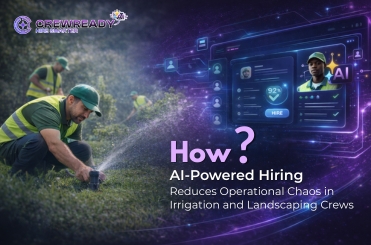
You post a job on Monday. By Wednesday, you have 60 applications. By Friday, three interviews are scheduled, two candidates don’t show up, and the one hired quits before their first shift. This is often the reality of hiring landscaping crews. The season doesn’t wait, and every open position starts costing money fast.
The industry is facing a real labor shortage. More than 374,000 positions were unfilled at the beginning of last landscaping season, contributing to an estimated $5 billion gap across the sector. For companies relying on traditional hiring methods, this isn’t a temporary issue. It’s a structural problem that disrupts operations, delays projects, and cuts into revenue. For landscaping companies across the United States, hiring delays directly impact revenue and contract fulfillment.
Most landscaping and irrigation businesses understand the obvious cost of an open role: slower crews, missed timelines, and overtime expenses.
But other costs are incurred before the role is even filled.
Hiring teams spend hours sorting through unqualified applications, scheduling interviews that don’t pan out, and onboarding workers who aren’t the right fit. When a new hire quits without warning or underperforms, the entire process starts over.
Hiring field workers for landscaping and irrigation comes with specific demands that general job platforms aren’t designed to handle. Candidates may look qualified on paper but lack hands-on experience with irrigation systems, equipment, or physically demanding outdoor work.
These aren’t rare cases. They’re common gaps in a hiring process that hasn’t evolved with the industry.
The typical hiring process is manual and time-consuming. It involves writing job posts, posting across platforms, reviewing applications, making screening calls, scheduling interviews, verifying experience, and extending offers.
Then repeating the cycle when things don’t work out.
During peak season, this creates a serious problem. Hiring managers can spend up to 40–60% of their time on recruitment instead of focusing on operations. Meanwhile, field supervisors stretch existing crews to cover gaps, leading to fatigue and burnout.
This is what operational chaos looks like in landscaping and irrigation. Not one major failure, but a constant buildup of small inefficiencies.
AI-powered hiring addresses the biggest breakdown in the process: the gap between job requests and getting qualified workers on-site.
Instead of overwhelming hiring managers with raw applications, AI-driven systems filter, score, and rank candidates based on role-specific needs like skills, location, availability, and physical requirements.
The speed difference is significant.
A manual hiring process can take days or even weeks to produce a qualified candidate. AI-powered platforms can reduce that time by up to 50% in high-volume field hiring environments.
For landscaping and irrigation companies working within tight seasonal windows, that time savings directly impacts revenue and project timelines.
One of the biggest challenges for landscaping companies is timing. When demand spikes, traditional hiring simply can’t keep up.
By the time job postings gain traction and generate enough qualified applicants, valuable time is already lost.
AI-powered staffing solutions solve this by maintaining a ready pipeline of pre-screened candidates. Instead of starting from scratch, companies can match with available workers in hours.
The job request-to-hire process becomes faster, simpler, and more predictable, improving hiring efficiency.
Operational issues in landscaping and irrigation crews often start long before work begins in the field.
They start with:
When the hiring funnel improves, everything downstream becomes more stable.
AI-powered hiring isn’t a quick fix for every problem, but it solves one of the most critical challenges: getting qualified, reliable workers in front of decision-makers quickly.
For companies looking to scale without sacrificing quality, that’s where the real value lies.
Operational chaos starts with the hiring process.
When the hiring process becomes more efficient, accurate, and reliable, crews stay productive, projects stay on track, and managers can focus on operations instead of constant recruitment.
AI-powered hiring brings structure to a process that has long been unpredictable.
For landscaping and irrigation companies, that’s a competitive advantage.
AI-powered hiring uses technology to match qualified field workers with open roles based on skills, experience, location, and job requirements. It helps companies find the right candidates faster while reducing manual screening.
CrewReady combines AI-driven matching with human verification to deliver pre-screened candidates who fit landscaping and irrigation roles. This reduces time spent reviewing applications and speeds up hiring decisions.
In many cases, companies receive matched, pre-screened candidates within hours instead of days or weeks, helping crews stay fully staffed during busy seasons.
If your landscaping or irrigation company is losing time, money, and critical seasonal hires to a slow hiring process, CrewReady offers a faster path from job request to hire often within hours, not days.
With AI-driven matching, pre-screened candidates, and human verification, hiring becomes something that supports your operations instead of slowing them down.
Takes less than 2 minutes. No commitment required.