
☰
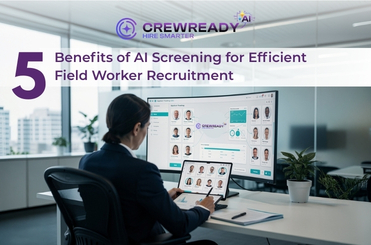
Field service businesses depend on reliable crews to deliver consistent work. Landscaping contractors, irrigation installers, and property maintenance teams all face the same operational constraint: hiring qualified field workers quickly enough to keep projects moving.
Yet the hiring process for field roles is often inefficient. Job boards generate large volumes of applicants, but many lack the required experience, availability, or commitment. Operations managers spend hours reviewing resumes, conducting initial phone screens, and filtering candidates who ultimately do not fit the role.
The problem is not a shortage of applicants; it’s the lack of structured screening before candidates enter the hiring pipeline.
AI-assisted screening, combined with human verification, addresses this gap by organizing candidate evaluation before interviews begin. The result is a hiring process that prioritizes operational fit rather than volume.
Below are five ways AI screening improves efficiency in field worker recruitment.
In traditional hiring workflows, the initial screening stage consumes the most time. Hiring managers must review dozens of applications before identifying a small number of viable candidates.
AI screening changes this process by analyzing candidate profiles against specific job requirements such as role experience, location, availability, and pay expectations. Instead of reviewing large volumes of applications, hiring teams receive a smaller group of candidates already aligned with the position.
This structured filtering shortens the early stages of recruitment and allows hiring managers to focus on evaluating fit rather than sorting through unqualified applicants.
For field service companies operating on tight project timelines, faster access to relevant candidates reduces the risk of staffing delays.
Manual screening creates a significant administrative burden for operations teams. Reviewing resumes, scheduling phone calls, and verifying candidate details can take hours each week.
AI-supported screening automates the initial filtering stage while human reviewers validate final candidate selections. This approach removes repetitive tasks from the hiring process without eliminating human judgment.
Operations managers can redirect their time toward project oversight, client coordination, and crew management instead of performing repetitive applicant screening.
In businesses where leadership teams already manage multiple operational responsibilities, reducing hiring administration creates measurable efficiency gains.
Many hiring mismatches occur because job descriptions and candidate qualifications are evaluated inconsistently during early screening stages.
Structured screening systems evaluate candidates against defined criteria such as:
This consistent evaluation framework helps ensure that candidates entering the interview stage already meet baseline expectations for the position.
When hiring teams interview candidates who match operational requirements more closely, decision-making becomes faster and more reliable.
Unstructured hiring processes create uncertainty for operations teams. Candidates may appear qualified initially but later decline the role, change availability, or fail to meet expectations during onboarding.
AI-supported screening improves predictability by identifying candidates who demonstrate stronger alignment with role requirements and availability expectations before interviews begin.
While no hiring process can eliminate risk entirely, structured screening reduces variability and increases the likelihood that candidates entering the interview stage are prepared to move forward with the role.
For businesses managing seasonal demand or project-based workloads, improved hiring predictability helps stabilize crew availability.
Hiring should support operations rather than disrupt them. When managers spend excessive time screening applicants, attention shifts away from project execution, customer service, and team performance.
AI-assisted screening allows hiring teams to review a curated group of candidates rather than managing the entire applicant pool.
This shift changes the role of hiring managers from screening administrators to decision-makers focused on crew quality and operational performance.
Over time, this structured approach supports a hiring pipeline that operates more consistently and with less administrative friction.
Efficient hiring is rarely about generating more applications. It is about introducing structure into the early stages of candidate evaluation.
When AI screening organizes applicant data and human reviewers validate candidate fit, the hiring pipeline becomes more predictable and less time-intensive.
For landscaping companies, irrigation installers, and other field service businesses, this structured approach reduces screening effort while improving the quality of candidates entering the interview stage.
The outcome is not simply faster hiring. It is a recruitment process that better supports operational stability and long-term workforce reliability.
If your team is looking to reduce manual screening and access pre-screened field workers faster, CrewReady provides a structured hiring pipeline designed for landscaping and irrigation businesses.
Takes less than 2 minutes. No commitment required.